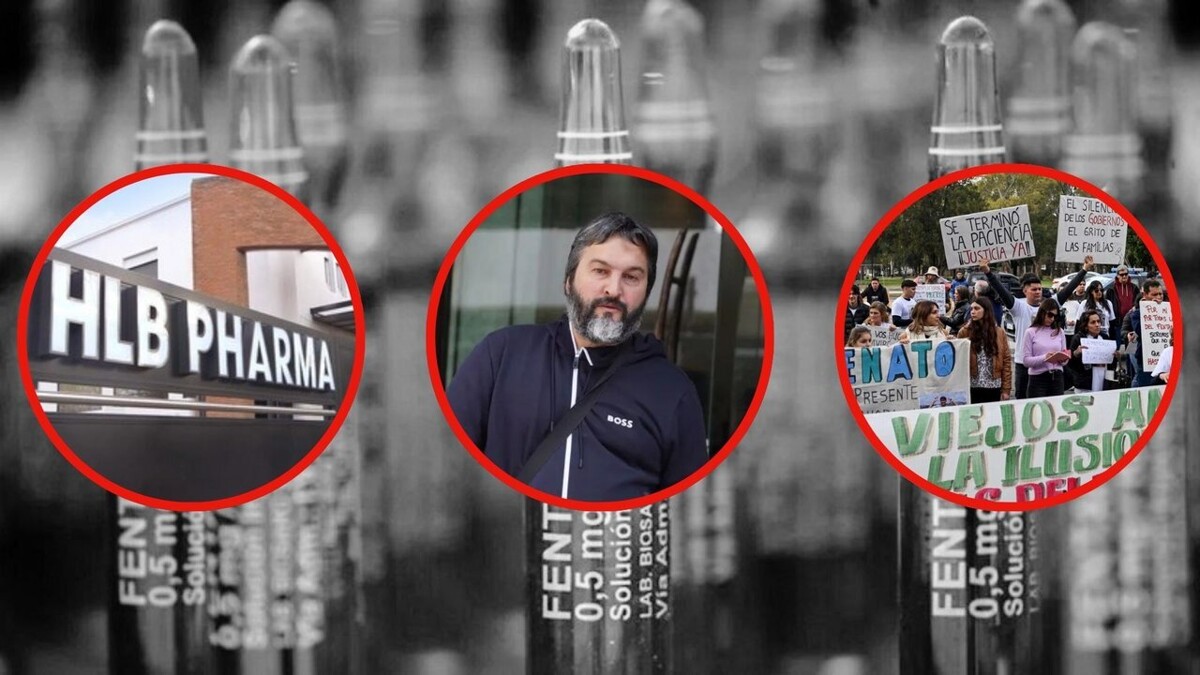
Argentina is facing one of its worst health scandals. In May 2025, the National Administration of Medicines, Food and Medical Technology (ANMAT) issued an alert warning against the use of fentanyl batch 31202, produced by HLB Pharma, across the national territory due to it being “under investigation for quality deviations.” Although only one batch is believed to be contaminated so far, there is suspicion that more may exist. The investigation's findings revealed that everyone was aware of the contamination in the vials, that there was no control or oversight from the authorities, and that the fentanyl was administered to several patients who later died.
Facing this harrowing situation, while family members were marching for justice for their loved ones, on August 20, the judge requested the immediate detention of García Furfaro, his brothers, his mother, shareholders of both firms, and technical personnel, who were also prosecuted. García Furfaro, an associate of the Kirchner family, is considered a “co-author criminally responsible for the crime of adulteration of medicinal substances” for causing the deaths of 20 people, “in conjunction with the crime of adulteration of medicinal substances in a dangerous manner for health, also as a co-author.”
The investigation began after the Italian Hospital of La Plata filed a complaint, alerting authorities to the discovery of two bacteria (Klebsiella pneumoniae and Ralstonia spp.) in the fentanyl vials, which may be associated with deaths that occurred within the medical institution. Since then, relatives of more than 173 deceased individuals have been seeking answers as to whether their loved ones were victims of the contaminated fentanyl. The case was assigned to the Federal Court No. 3 of La Plata, led by Ernesto Kreplak, with the involvement of entities such as ANMAT. The judge also ordered the firm to recover the product from the market, which had been distributed to over 300 hospitals in Argentina, and to halt production at the HLB Pharma plant “until the technical and sanitary conditions are found.”
Over more than six months of the investigation, three marches were held in La Plata and Rosario to bring visibility to the demands and keep the victims' names alive. The businessman is alleged to have been involved, along with 16 members of the staff of both laboratories, “in making different decisions related to the manufacture, distribution, and sale in the adulteration of batch 31202,” belonging to the opioid, which was “destined for public health use, with a production order issued on December 16, 2024.” The document emphasizes that “the adulteration of the medicinal substance consisted of its contamination from a manufacturing process characterized by multiple shortcomings, including several critical ones, regarding which there were multiple alerts that were not heeded.”
While the accused remain in custody, some under house arrest, important statements and reports have come to light. Among the most shocking testimonies are those from the accused themselves, as well as employees of the two laboratories, many of whom confirmed that they knew about the contamination but omitted the details to avoid losing sales. Furthermore, the latest document released by the Forensic Medical Corps of the Supreme Court indicated that in 38 of the 40 samples analyzed, it was confirmed that the administration of the contaminated opioid “was key to the fatal outcome of the patients.” Regarding the other two cases, it was stated that a direct link could not be established.
In parallel, an investigation was conducted in Congress for several months to ascertain what happened and the responsibilities behind the country's worst health tragedy. Last Tuesday, December 2, the Special Commission presented its final report, determining that the Argentine state failed to guarantee the traceability of fentanyl and effective control over the laboratories. It also found that hospitals concealed cases, that there was documentation “falsified post-facto” by the authorities of both laboratories, and that the control bodies acted late and inefficiently. For the commission members, the result is clear: the deaths from contaminated fentanyl were not an accident, but a chain of avoidable failures, cover-ups, lack of control, and a laboratory operating with inconsistent records, confirmed even by its own employees.
Meanwhile, relatives continue to demand justice and for the responsible parties to be convicted for causing the country's worst health crisis linked to the inoculation with a bacteria-contaminated opioid. The same occurred with Laboratorios Ramallo S.A., as the vials are said to have been manufactured in their facilities. Both companies belong to the tycoon Ariel García Furfaro. It was learned that so far in 2025, the laboratories have received several alerts and bans from ANMAT for non-compliance and traceability issues with dopamine, propofol, diclofenac, morphine, and fentanyl.
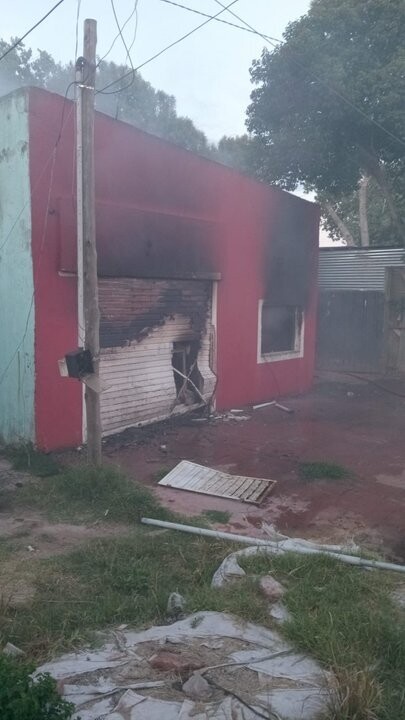
As a first instance against the 24 accused, it was reported that assets were frozen and a travel ban was imposed on several of those involved. Raids were also conducted, in which it was determined that in Cables Epuyén SRL, belonging to Damian García Furfaro, brother of the owner of HLB Pharma, 29 pallets of various medications were found. This is approximately a full truckload containing diclofenac and paracetamol, all under the signature of the laboratory in question. Another piece of evidence presented was a mountain of fentanyl vials found in one of the courtyards of the Ramallo S.A. laboratory, for which the preservation of the site, photographic samples, and a sketch by the forces guarding the sealed laboratory were ordered, and urgent personnel from the provincial Ministry of the Environment were required to attend. At this time, not a single vial has been accounted for.
On May 13, ANMAT issued another alert prohibiting the use, marketing, and distribution of that specific batch nationwide. Authorities reported that of the 154,530 vials distributed, 27.5% would have been administered to patients. For several weeks, the intervening court conducted various reports and expert examinations to corroborate the details behind the adulterated opioid.